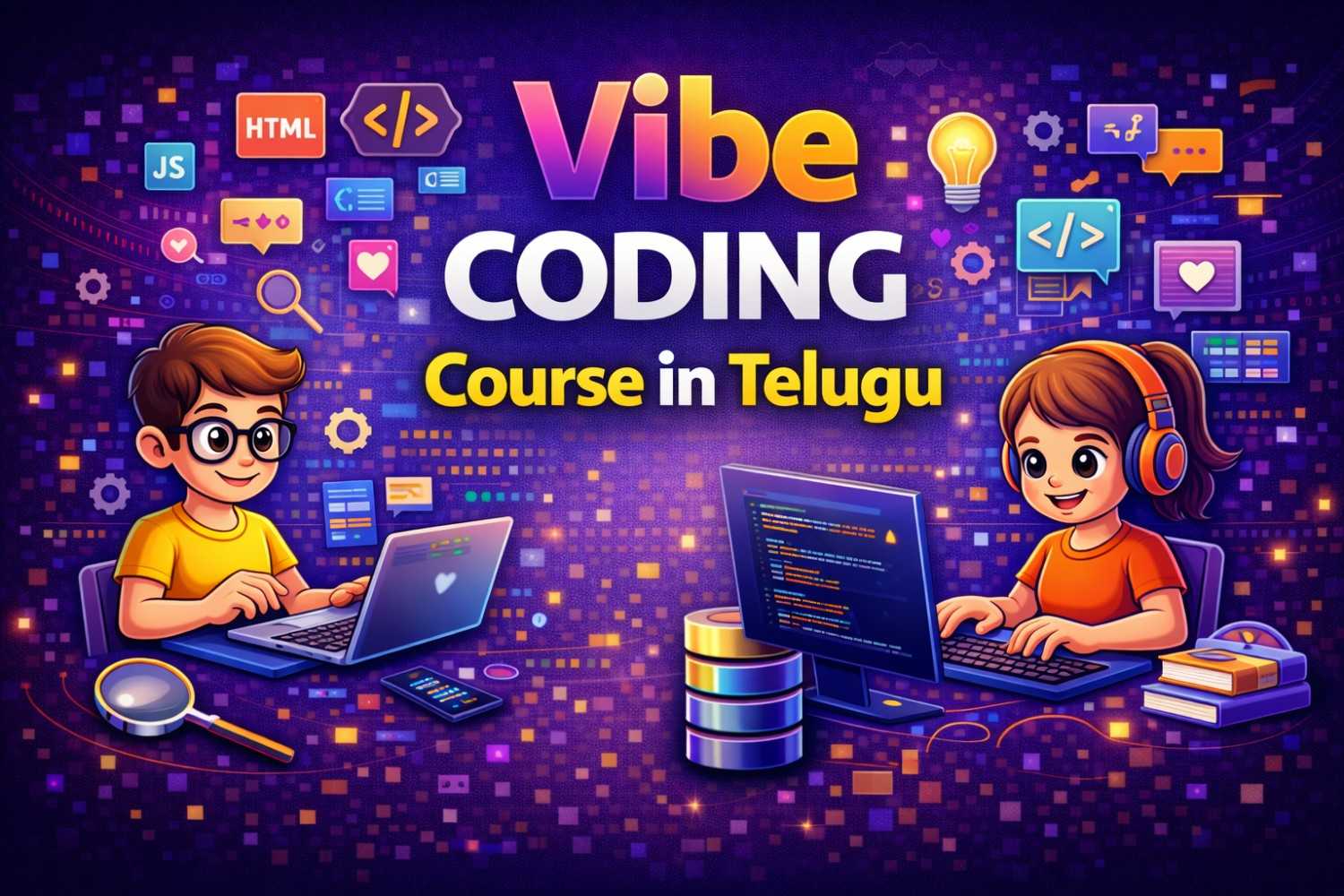
Vibe Coding Course in Telugu: Learning Coding by Flow
Introduction: What If Coding Felt More Human?
When people talk about coding, they often describe it as something mechanical—rules, syntax, errors, and logic stacked on top of logic. For beginners, this description alone is enough to create fear. Many learners feel that coding is cold, rigid, and only meant for people with a strong technical background.
But coding was created by humans, for humans. At its core, it is simply a way to tell a computer what to do, step by step. When learning focuses too much on rules and too little on understanding, coding feels unnatural. This gap between how coding is taught and how people naturally learn gave rise to a more intuitive approach known as vibe coding. That is why many learners today are curious about a Vibe Coding Course in Telugu—to learn coding in a way that feels logical, comfortable, and engaging.
What Is Vibe Coding?
Vibe coding is not a programming language and not a shortcut. It is a learning approach that helps beginners connect with coding naturally. Instead of memorizing syntax first, learners observe how code behaves and slowly build understanding.
In vibe coding:
Learners focus on flow, not formulas
Logic is understood through examples
Errors are treated as learning signals
Curiosity leads the process
The term “vibe” refers to sensing how code works—its rhythm, cause, and effect.
Why Many Beginners Struggle With Coding
Most beginners do not struggle because coding is impossible. They struggle because the learning process feels disconnected from how the brain works.
Common beginner challenges include:
Too much theory at the start
Fear of making mistakes
Confusing error messages
Pressure to be perfect
Traditional learning often demands understanding before experience. Vibe coding reverses this by offering experience first and explanations later.
How Vibe Coding Changes the First Learning Experience
The first few days of learning coding are critical. If learners feel confused early, they often quit.
Vibe coding improves this stage by:
Showing visible results early
Encouraging experimentation
Allowing learners to “play” with code
Reducing fear of errors
Instead of asking “Did I write this correctly?”, learners ask “What changed when I did this?”
What Learners Actually Understand Through Vibe Coding
A Vibe Coding Course in Telugu focuses on building understanding step by step rather than overwhelming learners.
Learners slowly begin to understand:
How code runs line by line
Why order matters in programming
How small changes affect output
How to debug by observing behavior
This creates intuition, which is essential for long-term coding skills.
Vibe Coding and the Brain’s Learning Style
Humans learn best through patterns and repetition. Vibe coding aligns perfectly with this natural process.
It helps by:
Reinforcing logic through repetition
Allowing learners to predict outcomes
Strengthening cause-and-effect thinking
Making learning interactive
Over time, learners stop guessing and start reasoning.
Is Vibe Coding Too Relaxed to Be Serious?
Some people misunderstand vibe coding as casual or unstructured. In reality, it is structured differently.
Vibe coding:
Does not avoid logic
Does not ignore fundamentals
Does not remove discipline
It simply delays complexity until the learner is ready.
Real-World Use of Vibe Coding Skills
Even though vibe coding feels beginner-friendly, the skills gained are practical.
They help learners:
Understand how applications work
Transition easily to structured programming
Build confidence with new languages
Think clearly when solving problems
Vibe coding often becomes the foundation for deeper technical growth.
How Vibe Coding Builds Problem-Solving Skills
Problem-solving is the heart of programming.
Vibe coding improves this by:
Encouraging exploration
Teaching learners to test assumptions
Helping them break problems into steps
Promoting patience and persistence
These skills are valuable beyond coding as well.
Learning Pace in Vibe Coding
Vibe coding follows a gentle learning curve.
Instead of:
- High pressure → confusion → quitting
Learners experience:
- Curiosity → understanding → confidence
This steady progress keeps learners motivated.
Why Learn Vibe Coding in Telugu
Learning vibe coding in Telugu allows learners to understand ideas directly, without mentally translating concepts from another language. When explanations feel familiar, learners can focus on logic and flow instead of struggling with terminology, making coding feel natural and approachable from the beginning.
Who Is Vibe Coding Best For?
Vibe coding is ideal for:
Absolute beginners
Non-technical professionals
Creative thinkers
Students exploring technology
People restarting their coding journey
No prior coding experience is required.
Challenges in Vibe Coding
Like any learning approach, vibe coding has challenges:
Learners must later learn proper syntax
Practice is still essential
Discipline remains important
However, these challenges feel manageable once fear is removed.
Vibe Coding as a Learning Philosophy
Vibe coding is more than a method—it is a mindset.
It promotes:
Curiosity over fear
Understanding over memorization
Exploration over pressure
Confidence over hesitation
This mindset helps learners stay consistent.
The Growing Relevance of Vibe Coding
As education becomes more learner-focused, intuitive methods like vibe coding are gaining attention. Beginner-friendly approaches help more people enter the technology space without feeling overwhelmed.
Vibe coding may become the bridge between curiosity and advanced programming skills.
Conclusion: Can Coding Feel Natural Instead of Stressful?
Vibe coding challenges the belief that programming must be rigid and intimidating. By focusing on flow, intuition, and understanding, it allows learners to approach coding with curiosity instead of fear.
If coding can be learned naturally by observing, experimenting, and understanding flow, how many people might unlock their potential through vibe coding? And could starting with a Vibe Coding Course in Telugu be the most comfortable way to begin a coding journey today?